|
CHP Systems
CHP Systems Ad Space Available Through the Renewable Energy Institute
________________________________________________________________ “spending hundreds and hundreds and hundreds of billions of dollars every year for oil, much of it from the Middle East, is just about the single stupidest thing that modern society could possibly do. It’s very difficult to think of anything more idiotic than that.” - R. James Woolsey, Jr., former Director of the CIA
and the
|
_____________________________________________________
CHP Systems
www.CHPsystems.com
CHP Systems
What are CHP Systems?
A CHP System - also known as a cogeneration plant, is the simultaneous production of power and thermal energy. Stated another way, a CHP System integrates an onsite, "decentralized energy" (DE) system with thermally-activated power and energy technologies for heating and cooling.
CHP Systems are more commonly referred to as "Trigeneration" plants and also referred to as:
Cogeneration plus Absorption Chillers - or - ADsorption Chillers
CHP Systems are also at the center of every District Energy System.
CHP Systems, District Energy Systems, Integrated Energy Systems, or Trigeneration plants, no matter how they are referred, achieve overall, net system energy efficiencies of 80% plus, and several Trigeneration plants are nearing 90% efficiencies nearing almost 300% increased efficiency over power provided by electric utilities and their central power plants"! This means significantly lowered:
energy costs
fuel costs
CHP
Systems achieve these greater energy efficiencies
through the conversion of exhaust or reject heat from power generation into
needed energy services like cooling and heating of buildings as well as
campuses. This is called "Waste
Heat Recovery" or "Recycled
Energy." Development of "packaged" or
"modularized" CHP
Systems for end-use applications, such as commercial and
institutional buildings, is something the founder of our company has been
involved with since the mid 1980's.
In the past, Cogeneration
plants have been economically attractive only in sizes above several megawatts.
The emergence of a number of small generation technologies, including fuel
cells, advanced low emissions engines, and gas
turbines with outputs in the 1000 kW - 5000 kW range, should extend
the benefits of Integrated
Energy Systems to a much larger user base, with a consequent increase
in national energy and environmental benefits.
For example, the application of CHP Systems (including Absorption Chillers - or - ADsorption Chillers) in commercial buildings could reduce commercial building energy consumption by 30%.
Application
of such smaller-scale packaged CHP
Systems provides a major breakthrough in energy efficiency
technology, energy savings as well as reduced greenhouse
gas emissions. And, by locating
the power generation at or near the end-user/consumer, i.e. their facility,
building, or campus, the difficulties in siting and building new electric
transmission and electric distribution infrastructures to meet today's
increasing power demand are minimized.
The most promising markets for Trigeneration
plants, CHP Systems,
District
Energy Systems or Integrated
Energy Systems are commercial or institutional buildings, government
facilities, and district energy systems that distribute thermal energy to
buildings in a college campus, hospital complex, industrial park, food
processing operations, refrigerated warehouses, and also very attractive for
cities.

_______________________________________________________
_____________________________________________________
About us:
We provide engineering and renewable energy project development services including including;
Concentrated Solar Power - CSP
Economic Feasibility Analysis
Feasibility Studies
Front End Engineering Design - FEED
Greenhouse Gas Emissions consulting
Interconnection Studies
Organic Rankine Cycle - ORC
Power Purchase Agreement consulting & PPA fundingProject Development
Project Management
Project Finance/Funding introduction to potential investors
Our work is performed on a strict adherence to "vendor-neutrality." We are client and project focused and seek to maximize our client's return on their investment while simultaneously minimizing their operational expenses and environmental exposure.
Engineering and related interim project development expenses may be at client's expense but will be refunded at the close of Power Purchase Agreement or other project financing. Some of our engineering and related EPC services provided by our top-ranked ENR Engineering/EPC partner companies .
For qualified clients we will design, build, finance, own,
operate and maintain a new:
energy system, through a Power
Purchase Agreement that guarantees
a minimum 10% reduction in our client's energy expenses.
(NOTE: Engineering and related
interim
project development expenses may be at client's expense
but will be
refunded at the close of Power
Purchase Agreement or other project financing. Some of our engineering
and EPC services may be provided by one of our Top-ranked ENR Engineering/EPC partner companies.)
To
receive a preliminary no obligation consult, send us a summary concerning your
energy, engineering or project plans:
![]()
____________________________________________________
What is "Cogeneration"?
Did you know that 10% of our nation's electricity now comes from "cogeneration" plants?
And
because cogeneration
is so efficient, it saves its customers up to 40% on their energy expenses,
and provides even greater savings to our environment through significant
reductions in fuel usage and much lower greenhouse
gas emissions.
Cogeneration
- also known as “combined
heat and power” (CHP), cogen, district energy, total energy, and
combined cycle, is the simultaneous production of heat (usually in the form of
hot water and/or steam) and power, utilizing one primary fuel such as natural
gas, or a renewable fuel, such as Biomethane,
B100 Biodiesel,
or Synthesis Gas.
Cogeneration technology is not the latest industry buzz-word being touted as the solution to our nation's energy woes. Cogeneration is a proven technology that has been around for over 120 years!
Our nation's first commercial power plant was a cogeneration plant that was designed and built by Thomas Edison in 1882 in New York. Our nation's first commercial power plant was called the "Pearl Street Station."
What
is a Combined Cycle
Plant?
A combined cycle plant combines the Rankine Cycle (steam turbine) and Brayton Cycle (gas turbine) thermodynamic cycles by using waste heat recovery boilers to capture the energy in the gas turbine exhaust gases for steam production to supply a steam turbine as shown in the figure below.
Process steam
can be also provided for industrial purposes.
Fossil fuel-fired (central) power plants use either steam or combustion turbines to provide the mechanical power to electrical generators. Pressurized high temperature steam or gas expands through various stages of a turbine, transferring energy to the rotating turbine blades. The turbine is mechanically coupled to a generator, which produces electricity.
____________________________________________________
Steam Turbine Power Plants:
Steam turbine power plants operate on a Rankine cycle. The steam is created by a boiler, where pure water passes through a series of tubes to capture heat from the firebox and then boils under high pressure to become superheated steam. The heat in the firebox is normally provided by burning fossil fuel (e.g. coal, fuel oil or natural gas). However, the heat can also be provided by biomass, solar energy or nuclear fuel. The superheated steam leaving the boiler then enters the steam turbine throttle, where it powers the turbine and connected generator to make electricity. After the steam expands through the turbine, it exits the back end of the turbine, where it is cooled and condensed back to water in the surface condenser. This condensate is then returned to the boiler through high-pressure feedpumps for reuse. Heat from the condensing steam is normally rejected from the condenser to a body of water, such as a river or cooling tower.
Steam turbine plants generally have a history of achieving up to 95% availability and can operate for more than a year between shutdowns for maintenance and inspections. Their unplanned or forced outage rates are typically less than 2% or less than one week per year.
Modern large steam turbine plants (over 500 MW) have efficiencies approaching 40-45%. These plants have installed costs between $800 and$2000/kW, depending on environmental permitting requirements.
Combustion turbine plants operate on the Brayton cycle. They use a compressor to compress the inlet air upstream of a combustion chamber. Then the fuel is introduced and ignited to produce a high temperature, high-pressure gas that enters and expands through the turbine section. The turbine section powers both the generator and compressor. Combustion turbines are also able to burn a wide range of liquid and gaseous fuels from crude oil to natural gas.
The
combustion turbine’s energy conversion typically ranges between 25% to 35%
efficiency as a simple cycle. The
simple cycle efficiency can be increased by installing a recuperator or waste
heat boiler onto the turbine’s exhaust. A
recuperator captures waste heat in the turbine exhaust stream to preheat the
compressor discharge air before it enters the combustion chamber.
A waste heat boiler
generates steam by capturing heat form the turbine exhaust.
These boilers are known as heat
recovery steam generators (HRSG). They can provide steam for heating or
industrial processes, which is called cogeneration.
High-pressure steam from these boilers can also generate power with steam
turbines, which is called a combined cycle (steam and combustion turbine
operation). Recuperators and heat
recovery steam generators can increase the combustion turbine’s overall
energy cycle efficiency up to 80%.
Combustion (natural gas) turbine development increased in the 1930’s as a
means of jet aircraft propulsion. In the early 1980’s, the efficiency and
reliability of gas turbines had progressed sufficiently to be widely adopted for
stationary power applications. Gas turbines range in size from 30 kW
(micro-turbines) to 250 MW (industrial frames).
Industrial gas turbines have efficiencies approaching 40% and 60% for
simple and combined cycles respectively.
The gas turbine share of the world power generation market has climbed from 20 % to 40 % of capacity additions over the past 20 years with this technology seeing increased use for base load power generation. Much of this growth can be accredited to large (>500 MW) combined cycle power plants that exhibit low capital cost (less than $550/kW) and high thermal efficiency.
The capital cost of a gas turbine power plant can vary between $35000-$950/kW with the lower end applying to large industrial frame turbines in combined cycle configurations. Availability of natural gas-fired plants can exceed 95%. In Canada, there are 28 natural gas-fired combined cycle and cogeneration plants with an average efficiency of 48 %. The average power output for each plant was 236 MW with an installed cost of around $ 500/kW.
What is Combined
Heat and Power?
Combined
heat and power, also known
as "cogeneration"
or CHP and "total energy," is a highly-efficient, environmentally
friendly and clean energy technology for generating power and
thermal energy from a single fuel source. That is, Cogeneration
uses heat that is otherwise discarded from conventional power generation to
produce thermal energy. This energy is used to provide cooling or heating for
industrial facilities, district energy systems, and commercial buildings. By
recycling this waste heat, cogeneration
systems achieve typical effective electric efficiencies of 70% to 80% — a
dramatic improvement over the average 33% efficiency of conventional utility
companies, "central
power plants."
Cogeneration's higher efficiencies reduce air emissions of nitrogen oxides, sulfur dioxide, mercury emissions, particulate matter, and carbon dioxide, the leading greenhouse gas emissions associated with climate change.
____________________________________________________
Power
Purchase Agreement
www.PowerPurchaseAgreement.com
What is a Power
Purchase Agreement?
A Power
Purchase Agreement is a legal
agreement wherein our clients agree to buy either the power (electricity) or the
power and energy (hot water, steam and/or chilled water for air-conditioning) -
or both - directly from us, for a term of 10 to 20 years, where we have
installed, own and operate our solar energy systems.
In nearly every case, once we have installed our solar energy systems at our client's facility, we can immediately reduce our (commercial) client's electricity expenses by 10% over what they were paying for their power electricity from their electric utility.
The right Power Purchase Agreement, solar cogeneration or solar trigeneration energy solution, may save your company hundreds of thousands, and possibly millions of dollars over the term of the agreement.
Simultaneously, having the wrong or poorly drafted PPA can cost your company thousands or millions of dollars. You wouldn't consult a brain surgeon to treat your child's broken bone! Selecting the wrong attorneys, law firm or team to promulgate or re-negotiate your Power Purchase Agreement can leave you "powerless" and penniless - and still requiring the skills and expertise of competent and qualified professionals to resolve the situation.
Because a Power Purchase Agreement is at the "heart" and underlying foundation of our projects, we can help your business with the selection and oversight of PPA's.
We can help your city or community create a Municipal Utility District or Public Utility District that may then qualify for our very competitively priced energy and electricity rates. Now is the time for cities, municipal and governmental clients to consider having our company install one of our renewable power and energy systems that will generate "clean" power and energy, lower costs, and avoid the coming electricity shortages and grid congestion problems!
Products and services provided by us include the following power and energy project development services:
Project Engineering Feasibility & Economic Analysis Studies
Engineering, Procurement and Construction
Environmental Engineering & Permitting
Project Funding & Financing Options; including Equity Investment, Debt Financing, Lease and Municipal Lease
Shared/Guaranteed Savings Program with No Capital Investment from Qualified Clients
Project Commissioning
3rd Party Ownership and Project Development
Long-term Service Agreements
Operations & Maintenance
Green Tag (Renewable Energy Credit, Carbon Dioxide Credits, Emission Reduction Credits) Brokerage Services; Application and Permitting
A
simple cycle power plant, also called
an open cycle, is comprised of a gas turbine package comprised of a compressor,
combustor, power turbine, and generator, as shown in the figure
"Simple-Cycle Gas Turbine".
In a gas turbine, large volumes of air are compressed to high pressure in a
multistage compressor for distribution to one or more combustion gases from the
combustion chambers power an axial turbine that drives the compressor and the
generator before exhausting to atmosphere. In this way, the combustion gases in
a gas turbine power the turbine directly, rather than requiring heat transfer to
a water/steam cycle to power a steam turbine, as in the steam plant. The latest
gas turbine designs use turbine inlet temperatures of 1,500C (2,730F) and
compression ratios as high as 30:1 (for aeroderivatives) giving thermal
efficiencies of 35 percent or more for a simple-cycle gas turbine.
_______________________________________________________
What is "Trigeneration"?
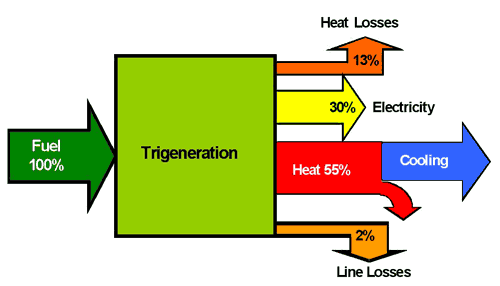
Trigeneration is the simultaneous production of three forms of energy - typically, Cooling, Heating and Power - from only one fuel input. Put another way, our trigeneration power plants produce three different types of energy for the price of one.
Trigeneration energy systems can reach overall system efficiencies of 86% to 93%. Typical "central" power plants, that do not need the heat generated from the combustion and power generation process, are only about 33% efficient.

Trigeneration
Diagram & Description
Trigeneration Power Plants' Have the Highest System Efficiencies and are
About 300 % More Efficient than Typical Central Power Plants
Trigeneration
plants are installed at locations that can benefit from all three forms of
energy. These types of installations that install trigeneration
energy systems are called "onsite power generation" also referred to as
"decentralized energy."
One of our company's principal's first experience with the design and development of a trigeneration power plant was the trigeneration power plant installation at Rice University in 1987 where our trigeneration development team started out by conducting a "cogeneration" feasibility study. The EPC contractor that Rice University selected installed the trigeneration power which included a 4.0 MW Ruston gas turbine power plant, along with waste heat recovery boilers and Absorption Chillers. A "waste heat recovery boiler" captures the heat from the exhaust of the gas turbine. From there, the recovered energy was converted to chilled water - originally from (3) Hitachi Absorption Chillers - 2 were rated at 1,000 tons each, and the third Hitachi Absorption Chiller was rated at 1,500 tons. The Hitachi Absorption Chillers were replaced shortly after their installation by the EPC company. The first trigeneration plant at Rice University was so successful, they added a second 5.0 MW trigeneration plant so today, Rice University is now generating about 9.0 MW of electricity, and also producing the cooling and heating the university needs from the trigeneration plant and circulating the trigeneration energy around its campus.

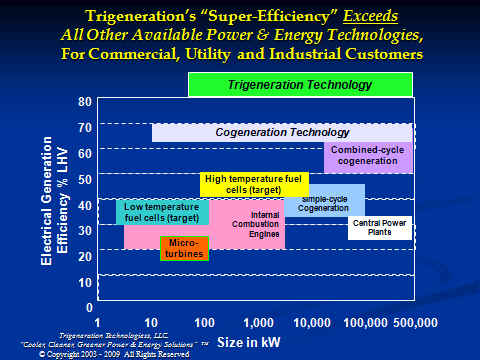
Trigeneration Chart
Trigeneration's
"Super-Efficiency" compared
with other competing technologies
As you can see, there is No Competition for Trigeneration!
Our trigeneration power plants are the ideal onsite power
and energy solution for customers that include: Data
Centers, Hospitals, Universities, Airports, Central Plants, Colleges
& Universities, Dairies, Server Farms, District Heating & Cooling
Plants,
Food Processing Plants, Golf/Country
Clubs, Government Buildings, Grocery Stores, Hotels, Manufacturing
Plants,
Nursing Homes, Office
Buildings / Campuses,
Radio Stations, Refrigerated
Warehouses,
Resorts,
Restaurants,
Schools, Server Farms, Shopping Centers, Supermarkets, Television
Stations, Theatres and Military Bases.
At about 86% to 93% net system efficiency, our trigeneration power plants are about 300% more efficient at providing energy than your current electric utility. That's because the typical electric utility's power plants are only about 33% efficient - they waste 2/3 of the fuel in generating electricity in the enormous amount of waste heat energy that they exhaust through their smokestacks.
Trigeneration is defined as the simultaneous production of three energies: Cooling, Heating and Power. Our trigeneration energy systems use the same amount of fuel in producing three energies that would normally only produce just one type of energy. This means our customers that have our trigeneration power plants have significantly lower energy expenses, and a lower carbon footprint.
Our
New "Integrated" Trigeneration
Plants Have
Very High Efficiencies & Low Fuel Costs
The Effective Heat Rate is Approximately
4050 btu/kW & System Efficiency is 92%
Plants Have
Very High Efficiencies & Low Fuel Costs
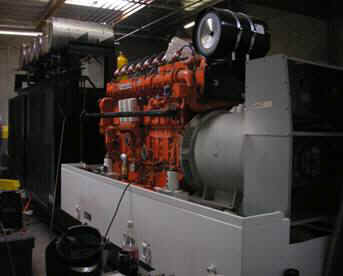
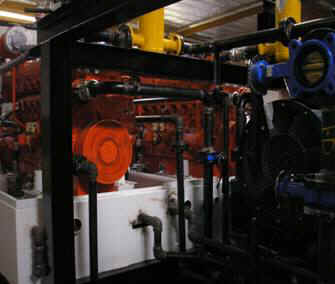
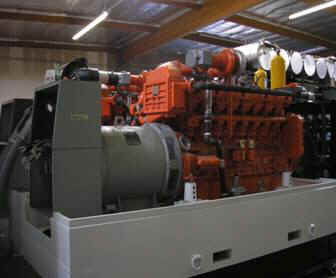
Pictures (below) of a Cogeneration Plant Presently Being Built for New Customer.
This Cogeneration
Plant is Rated at 900 kW and Features:
(2) Natural Gas Engines
@ 450 kW each on one Skid with Optional
Selective Catalytic Reduction system that removes Nitrogen
Oxides to "non-detect."


Our onsite trigeneration power and energy system can be an ideal solution for
customers wanting increased power reliability and decreased energy and
environmental costs. A few of the types of buildings and businesses that
would benefit from an onsite trigeneration
plant include the following:
Airports
Casinos
Central Plants
Colleges & Universities
Dairies
Data Centers
District Heating & Cooling plants
Food Processing Plants
Golf/Country Clubs
Government Buildings and Facilities
Grocery Stores
Hospitals
Hotels
Manufacturing Plants
Military Bases
Nursing Homes
Office Buildings / Campuses
Radio Stations
Refrigerated Warehouses
Resorts
Restaurants
Schools
Server Farms
Shopping centers
Supermarkets
Television Stations
Theatres
_______________________________________________________
What is the "Unified Smart Grid"?
The Unified Smart Grid is the name used for the future transmission power lines that would carry green electricity from the many solar power plants and solar power parks and wind farms that generate the power, typically in remote areas, to the "load centers" or major cities that would use the green power.
Quite simply, our country's out-dated and inefficient National Electric Grid, lacks the ability to carry all the new green electricity being planned from hundreds of new solar power parks and wind power generation facilities.
The Unified Smart Grid will be a national interconnected network relying on a high capacity backbone of electric power transmission lines linking all the nation's local electrical networks that have been upgraded to smart grids. Europe's analogous project is sometimes referred to as the SuperSmart Grid, a term that also appears in the literature describing the Unified Smart Grid.
Cost estimates to rebuild the nation's electric grid as a Unified Smart Grid have ranged from $350 billion to $450 billion.
Support for
the unified smart grid came with passage of the Energy Independence and Security Act of
2007. Title 13 of this Act invested $100 million in funding for the
years 2008 – 2012 and establishes a matching program to states, utilities and consumers to build
unified smart grid capabilities. It also creates a Grid Modernization Commission to assess the benefits of demand response
and automated demand response and recommended a set of system protocols and
standards to be led by the National Institute of Standards and Technology which
would coordinate the development of smart grid standards. FERC would then promulgate
these standards and protocols for the unified smart grid through its official
rulemaking capabilities.
The Unified
Smart Grid received further support with the passage of the American Recovery and Reinvestment Act of
2009 that set aside $11 billion for the creation of a smart grid.
Building
a Unified
Smart Grid
would
help jump-start the renewable
energy investments in solar power
parks. Thousands of megawatts of new solar
power parks (both Concentrating
Solar Power plants and Photovoltaic Power Plants) are being planned. Most
are located in the desert Southwest due to the solar energy resource. A Unified
Smart Grid
is
needed to move the large amount of power, which is fairly concentrated, to the
rest of the nation. Without the new Unified
Smart Grid, it
would be impossible to distribute the green power to the nation.
The new Unified Smart Grid is significantly more efficient than the present, nearly 100 year old technology that makes up our nation's present transmission and distribution network of how we get the power from central power plants to customers and major load centers.
Much of the new Unified Smart Grid will be comprised of "High Voltage Direct Current" transmission lines which is significantly more efficient than the present high voltage alternating current transmission lines.
The new Unified Smart Grid will provide economic development, thousands of new jobs, and significantly reduce greenhouse gas emissions.
What
would the new Unified
Smart Grid look like?

Source: American Electric Power
__________________________________________________
For more information on the Unified Smart Grid, visit one of the following sites:
Central Power
Plant
www.CentralPowerPlant.com
Electric Power
Generation
www.ElectricPowerGeneration.net
High
Voltage Direct Current
www.HighVoltageDirectCurrent.com
National
Electric Grid
www.NationalElectricGrid.com
Transmission
and Distribution
www.TransmissionAndDistribution.net
Unified Smart
Grid
www.UnifiedSmartGrid.com
Wind
Power Generation
www.WindPowerGeneration.com
_______________________________________________________
You Can't
Have a Unified
Smart Grid Without:
Advanced Metering System * Advanced Meters * Automated Demand Response * Automated Energy Management
Battery Energy Storage * Building Automation Systems * Carbon Free Energy * Clean Power Generation
Cogeneration * Compressed Air Energy Storage * Decentralized Energy * Demand Side Management
Dispersed Generation * Distributed Energy Resources * Distributed Generation * Distributed PV * EcoGeneration
High Voltage Direct Current * Load Leveling * Locational Marginal Pricing * Micro-Grid * Net Zero Energy
Net Zero Energy Buildings * Nodal Pricing * Onsite Power Generation * Pollution Free Power
Plug In Electric Vehicles * Renewable Energy Parks * Rooftop PV * Solar Cogeneration
Solar Power Parks * Trigeneration * Virtual Power Plants * Waste Heat Recovery
_______________________________________________________
Waste
Heat Recovery in Cogeneration
and
Trigeneration power and energy
systems
In
most cogeneration and
trigeneration
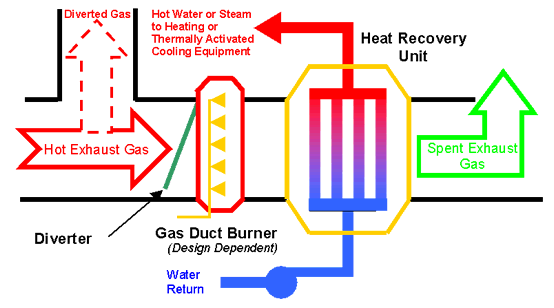
power and energy systems, the exhaust gas from the electric generation
equipment is ducted to a heat exchanger to recover the thermal energy in the
gas. These heat exchangers are air-to-water heat exchangers, where the exhaust
gas flows over some form of tube and fin heat exchange surface and the heat
from the exhaust gas is transferred to make hot water or steam. The hot water
or steam is then used to provide hot water or steam heating and/or to operate
thermally activated equipment, such as an absorption
chiller for cooling or a desiccant dehumidifer for dehumidification.
Many of the waste heat recovery technologies used in designing/building cogeneration and trigeneration energy systems require hot water, some at moderate pressures of 15 to 150 psig. In the cases where additional steam or pressurized hot water is needed, it may be necessary to provide supplemental heat to the exhaust gas with a duct burner.
In some applications air-to-air heat exchangers can be used. In other instances, if the emissions from the generation equipment are low enough, such as is with many of the microturbine technologies, the hot exhaust gases can be mixed with make-up air and vented directly into the heating system for building heating.
In the majority of installations, a flapper damper or "diverter" is employed to vary flow across the heat transfer surfaces of the heat exchanger to maintain a specific design temperature of the hot water or steam generation rate.
Typical
Waste Heat Recovery Installation
In some cogeneration and
trigeneration
energy designs, the exhaust gases can be used to activate a
thermal wheel or a desiccant dehumidifier. Thermal wheels use the exhaust gas
to heat a wheel with a medium that absorbs the heat and then transfers the
heat when the wheel is rotated into the incoming airflow.
A professional engineer should be involved in designing and sizing of the waste heat recovery section. For a proper and economical operation, the design of the heat recovery section involves consideration of many related factors, such as the thermal capacity of the exhaust gases, the exhaust flow rate, the sizing and type of heat exchanger, and the desired parameters over a various range of operating conditions of the cogeneration and/or trigeneration energy system — all of which need to be considered for proper and economical operation.
For more information on Waste Heat Recovery, call/email us.
_______________________________________________________
What is the Graz Cycle?
The Graz Cycle is the only thermodynamic combustion cycle that allows for the retention and capture of carbon dioxide emissions from the combustion of fossil fuels.
The Graz Cycle burns fossil fuel along with pure oxygen thereby enabling for the cost-effective separation of the carbon dioxide emissions from the combustion process through condensation. The additional expense for supplying the oxygen for the combustion process - and requirements for an air separation unit, are compensated, in part, through the increase in cycle efficiencies that exceed 65%. The combined efficiency of the Graz Cycle equals of exceeds the thermodynamic performance of other serious contenders in Carbon Capture and Sequestration (CCS).
The Graz Cycle is the thermodynamic cycle that provides for a "zero emission power plant" which also has the highest available efficiencies using gas turbines. The Graz Cycle has also been heralded as a "zero emission" power plant.
In practice, net electrical cycle efficiencies for Graz Cycle power plants have exceeded 65% - which is far higher than typical of state-of-the-art combined cycle plants.
According to the DOE web site, the Graz Cycle consists of a high temperature Brayton cycle and a low temperature Rankine cycle with a Heat Recovery Steam Generator. The Graz Cycle is an oxy-fuel power cycle with the capability of retaining all the combustion generated CO2 for further use. Its cycle configuration aims at highest efficiency by reducing the heat extraction in the condenser to a minimum. A thermodynamic investigation of the Graz Cycle fired with natural gas (CH4) shows a net efficiency of 52.5%, if the efforts for oxygen supply and CO2 compression to liquefaction are considered. If synthesis gas can be used from an external synthesis gas plant at 500°C, efficiencies can rise up to 56%. Studies indicate that further efficiency improvements and simplification of the cycle are possible.
_______________________________________________________
You can easily and affordably reduce or eliminate your company's "carbon footprint."
Are you ready for these new "greenhouse gas reporting" regulations? We can help you get ready!
According to Monty Goodell, MBA, the Founder and Chairman of the Renewable Energy Institute, “Greenhouse Gas Emissions and Carbon Dioxide Emissions will be the world’s biggest commodity market and will probably soon be the world’s largest market, period." In fact, Mr. Goodell anticipates that Greenhouse Gas Emissions and Carbon Dioxide Emissions will become one of the fasting-growing commodities and markets ever.
Every day, leading companies are spending millions of dollars going "GREEN" and reducing their Greenhouse Gas Emissions.
The Greenhouse Gas Emissions and Carbon Dioxide Emissions Market Potential is staggering! According to a recent New York Times article, carbon trading is one of the “fastest-growing specialties in financial services.”
Already, Greenhouse Gas Emissions Trading and International Carbon Trading markets are worth in excess of $50 billion/year. The United Nations expects this market to be valued in excess of $2 Trillion/year by 2012 and others are saying this could easily exceed $5 Trillion/year within the next several years!
DO THE MATH on the Carbon Dioxide Emissions market!
You may be wondering, how can such a relatively new commodity grow so rapidly? Here in the USA, 40 billion tons of Carbon Dioxide Emissions are produced every year. At the present price of $50 per ton of carbon dioxide, the Carbon Dioxide Emissions market is valued at $2.0 Trillion (40 billion tons of Carbon Dioxide Emissions x $50.00/ton).
How to Reduce Your Carbon Footprint
Carbon Emissions, Carbon Dioxide Emissions, and Greenhouse Gas Emissions can be reduced or completely eliminated with renewable energy technologies, such as our Solar Energy Systems - including our super high efficiency Solar Cogeneration and Solar Trigeneration energy systems. Brown buildings can be upgraded in to green buildings and "Net Zero Energy Buildings" through the products and services that we offer.
Qualified commercial, government, industrial and municipal clients can affordably have one of our Solar Cogeneration and Solar Trigeneration energy systems installed, with ZERO up-front costs, with our Power Purchase Agreement. Call/email us to learn more and find out if your business qualifies.
____________________________________________________
Why We Need Renewable Energy,
and a Feed In
Tariff, NOW!
Monty Goodell, MBA, Founder and President of the Renewable Energy Institute, along with the Renewable Energy Institute's Scientific Advisory Board, which is comprised of several of our nation's leading experts, engineers, attorneys, professors and universities, is calling for our nation and all 50 states to adopt a Renewable Portfolio Standard (RPS) of at least 25% by 2025.
And even better than a Renewable Portfolio Standard, according to Mr. Goodell, is a "Feed In Tariff," which is the route Germany took, and why they have had such great success in their transition to a solar based economy. The fastest paths to jump-start the renewable energy industry, is through a "Feed In Tariff.
A Feed In Tariff is superior to a Renewable Portfolio Standard," according to Mr. Goodell. "For example, look at Germany's success in their transition to an economy based on the installation of solar energy systems, they adopted a Feed In Tariff, are further north from the Equator than we are here in the U.S., and they are placing solar panels on every rooftop and wind turbine generators throughout their country. They are leading the world in renewable energy technologies, primarily due to their early adoption of a Feed In Tariff"
What is a Feed In Tariff?
A Feed
In Tariff is a utility rate that is established by a state or federal
government, that requires a utility to pay higher electricity rates for green
electricity generated by the owners of the solar
energy systems, whether that is a homeowner or business owner. Feed
In Tariffs shifts the expenses of subsidizing green energy from taxpayers, to electricity ratepayers.
Feed In Tariffs also include guarantee
that the Feed In Tariffs' artificially
higher rates, will continue for periods as long as 25 years.
Germany's great success for jump-starting the solar energy industry there, first
established Feed In Tariffs in
1999. Germany now has about five times as many
solar photovoltaic panels installed as the United
States - even though their total combined installations of PV panels still
only account for about 0.5% of the electricity generated there.
"So, we go with a Feed In Tariff in lieu of a
Renewable Portfolio Standard.
Simultaneously, we need to start re-building our national
electric grid, and transforming it into 'Transmission
Superhighway' or 'Unified Smart
Grid' and dramatically
increase the nation's power supply as well as implement greater use of 'Energy
Efficiency Measures' - also referred to as Energy
Conservation Measures. And we need to implement "real" 'Demand Side Management' programs. Failure to
move in these areas and to do so immediately increases the risks to our country,
our national security and the climate" according to Mr. Goodell.
According to Mr. Goodell, our nation is at a crossroads and we have been 'over the Middle Eastern barrel of their fossil fuels' long enough. We must shift from energy dependence to energy independence and place significant emphasis and investments in our national energy security and lower greenhouse gas emissions.
Renewable energy, and only renewable energy provides the significant economic and environmental dividends our country now needs. Preferably, our fledgling renewable energy industry in the U.S., will be "jump-started" with a Feed In Tariff.
Some of the economic and environmental dividends that renewable energy will provide our country, include:
Creation of more than 3 million new jobs in the U.S..
Generate more than $1 trillion in economic impacts
Eliminates or Reduces Carbon Emissions and Greenhouse Gas Emissions
Significant reductions of oil imports
Reduce energy prices and save consumers as much as $50 billion on their energy bills
Elimination of billions of pounds of carbon dioxide emissions and other greenhouse gas emissions
Stimulate rural economies
Conserve natural gas supplies
Creates a clean, safe energy future
Position the US as a world leader in renewable energy technologies
According to the Energy Information Administration, the total US primary energy consumption is expected to increase from 100 quadrillion Btu (quads) in 2005 to 131 quads in 2030. However, the renewable electricity generation remains at 9% while use of coal increases 50 percent in 2030 to 57%. Ethanol use is expected to increase from 4 billion gallons in 2005 to 14.6 billion gallons in 2030, yet that is only about 8% of total gasoline consumption.
In January (2008) the National Climatic Data Center (NCDC) blamed the burning of fossil fuels as a key contributor to global warming and accelerating climate change. The NCDC warned that the rate of the warming is accelerating and that the rise in temperatures over the past 9 years is “unprecedented in the historical record." This was underscored in February (2008) in the consensus report by the Intergovernmental Panel on Climate Change that concluded with near certainty that human activity was the main contributor to global warming.
The renewable energy industry, single-handedly, provides a powerful argument and solutions for these problems.
Global warming and climate change are symptoms of a sick planet and the results of unrestrained "dumping" of huge amounts of pollution - in the form of carbon dioxide emissions and greenhouse gas emissions into the atmosphere.
The vast majority of carbon dioxide emissions and greenhouse gas emissions comes from "dirty" fossil fuels (coal, oil, and natural gas) used in making electricity at power plants and dirty fuels (gasoline and petroleum diesel) that run our internal combustion engines in our cars, trains, planes, and trucks. Our planet is home to millions and millions of internal combustion engines that run on dirty fossil fuels - whether they are fueled with gasoline for running our cars and lawnmowers or running on diesel fuel in the engines of trucks and ships like the very large crude carriers that transport the crude oil all around the world...... every internal combustion engine that is running on dirty fossil fuels is dumping millions and millions of tons of carbon dioxide emissions and greenhouse gas emissions into our atmosphere - which is aggravating and exacerbating our sick planet - and making manmade climate change and global warming more difficult to resolve through manmade remedies and solutions.
____________________________________________________
Why the U.S. Needs A "Unified Smart Grid"
According to Monty Goodell, the Chairman and Founder of the Renewable Energy Institute, "our country desperately needs to upgrade its' national electric grid. The grid of today is a relic from the past, that is inefficient and costly. Originally built in the 1930's, it is costing our nation approximately $120 billion every year due to its' outdated and out-lived existence. The national power grid as designed and built in the 1930's does not have the efficiencies and capabilities to keep pace with the national power grid's demands of today."
"What
we need" according to Mr. Goodell, is a "Unified Smart Grid"
which would be buried underground and "wheels" or transmits
the renewable power ("green electricity") from the wind farms of the
midwest, and solar farms of the southwest, and geothermal farms of the west, to
load centers throughout every corner of the U.S."
According to many estimates, the "Unified
Smart Grid" could be built for about $400 billion. Through its'
increased efficiencies, savings and reliability improvements that it will
provide, the nation's new "unified smart grid" will be paid in full,
in less than 4 years.
____________________________________________________
Greenhouse Gas
Emissions
Linked to
the Loss of Polar Bears
Photo courtesy of Alaska Image Library. U.S. Fish and Wildlife Service
____________________________________________________
The Advantages of Cogeneration and Trigeneration
Monty Goodell, MBA
Chairman
Renewable Energy Institute
Owners of commercial buildings and commercial businesses are increasingly seeking ways to use energy more efficiently. This is a direct result of dramatically increasing electric rates, decreased power reliability (blackouts, brownouts, rolling blackouts, and other power interruptions), as well as competitive and economic pressures to cut expenses, increase air quality, and reduce emissions of air pollutants and greenhouse gas emissions. The Kyoto Protocol, while not ratified in the United States, continues to be a major driver in much of the rest of the world. In the United States, "EcoGeneration" is becoming a preferred method to produce a company’s or facility’s power and energy requirements.
EcoGeneration defines the optimization of economic and ecological benefits in the power generation process. EcoGeneration produces huge savings for our environment through the reduction, or even elimination, of pollution associated with power and energy production. Additionally, EcoGeneration appeals to our customers’ economic bottom line by providing them with significant fuel and electrical savings.
Energy technologies that fall under the EcoGeneration category include: wind, solar, geothermal power plants, hydrogen fuel, hydrogen fuel cells, soybean (and other crude vegetable oil based) B100 Bio diesel fuels, biomethane, synthesis gas, E100 Ethanol, ocean/tidal power, waste to energy, waste to fuel and waste to watts, combined cycle, district energy, cogeneration, trigeneration, and even quadgeneration power plants. And without a doubt, one of the greenest EcoGeneration solutions is "waste heat recovery."
There are two major EcoGeneration initiatives and technologies that we will discuss in this article — cogeneration and the newer technology, trigeneration. Trigeneration is one of the most attractive options, and is even more efficient and economically rewarding than its cousin, cogeneration, as it is a more comprehensive technology in that trigeneration includes cooling, as well as heat and power. With a natural gas, biomethane, B100 Biodiesel, or synthesis gas fuel supply, customers can have the option of going off the electric grid entirely. Best of all, customers with waste streams such as a city's wastewater treatment system or a landfill, can integrate "waste to energy," "waste to fuel" and other "methane recovery" technologies such as anaerobic digesters, landfill gas to energy, to generate essentially free biomethane. And another technology, called "biomass gasification," can use other waste streams such as the sewage sludge from publicly owned treatment works (POTWs) also referred to as "wastewater treatment plants" (WWTP) and generate essentially-free synthesis gas, to fuel the cogeneration power plant at the POTW. Another huge savings for a city comes into play here as sewage sludge is a hazardous waste, and requires special handling and disposal at permitted facilities that can handle/dispose of the POTW's sewage sludge - costing anywhere from $50.00/ton to well over $100/ton, depending on location. By using the waste to fuel technology of biomass gasification - the city reduces its' liabilities as well as expenses of "wasting" the sewage sludge, and using it to fuel the cogeneration power plant at the POTW.
Cogeneration, also known as combined heat and power (CHP), is the simultaneous production of electricity and useful heat, usually in the form of either hot water or steam, from one primary fuel, such as natural gas. While not necessarily defined correctly, cogeneration has also been referred to as district energy, total energy, combined cycle, CHP and simply cogen.
Cogeneration has been mostly a technology used in the utilities and industrial marketplace.
Trigeneration, as the name implies, refers to three energies, and is defined as the simultaneous production of heat and power, just like cogeneration, except trigeneration takes cogeneration one step further by also producing chilled water for air conditioning or process use with the addition of absorption or adsorption chillers. Trigeneration, also referred to as CHCP (combined heating, cooling and power), BCHP (building cooling, heating and power) and integrated energy systems, permits even greater operational flexibility at businesses with demand for energy in the form of heating and cooling. Just as a cogeneration power plant captures and makes use of the waste heat, absorption or adsorption chillers capture the waste (or rejected) heat and produce chilled water.
Trigeneration systems are found in commercial applications typically where there is a need for air conditioning or chilled water by the customer.
When a trigeneration power system is installed on-site, that is, where the electrical and thermal energy is needed by the customer so that the electrical energy does not have to be transported hundreds of miles away, and the thermal energy is fully utilized, system efficiencies can reach and surpass 90 percent.
How Trigeneration Works: The Trigeneration Process
When compared to "central
power plants," trigeneration
energy systems;
are about 300% more efficient
represent a far superior investment
use far less fuel for the same power and energy delivered
results in a significant "emissions abatement" solution that no other energy technology can rival
when using a renewable fuel such as biomethane, B100 Biodiesel, E100 Ethanol (produced from sugar cane or sugar beets, etc. and not from corn) or synthesis gas, is the most environmentally-friendly and sustainable energy and power solutions available
Because of this, customer's with trigeneration energy systems generate far fewer, and nearly negligible amounts of pollution than if the customer received their electricity from the electric utility company using central power plants - as well as natural gas from the gas company for fueling their water heaters and boilers.
Trigeneration's superior efficiencies surpass even the latest state-of-the-art combined cycle cogeneration power plants by up to 50 percent. Coupled with a four-pipe system, hot water/steam and chilled water can be produced simultaneously for circulation throughout the building or campus (which would be referred to as a district energy system).
And size is not an impediment, since trigeneration systems can be installed, for example, in small commercial settings, such as restaurants, hotels, schools, office buildings, and shopping centers, to large applications such as petrochemical plants, refineries, and in a city's downtown area, providing the energy requirements for multiple buildings. And it will still provide system efficiencies of 90 percent.
History Of Cogeneration
Technology
Many people know that Thomas Edison built the first commercial power plant.
However, most people do not know that Edison's first commercial power plant
known as the "Pearl Street Station," built in 1882 in Lower
Manhattan, New York, was also a cogeneration
power plant!
Because cogeneration and trigeneration continue to be the most efficient method of generating electrical and thermal energy, in terms of energy output, the U.S. Department of Energy (DOE) has called for the doubling of electrical power generated from cogeneration power plants — from the existing 46 GW (one gigawatt = 1,000 MW) to 92 GW by the year 2010. When this goal is reached, cogeneration will represent about 14 percent of the total U.S. generating capacity of electricity. The American Council for an Energy-Efficient Economy (ACEEE) estimates that an additional 95 GW of cogeneration capacity could be added between 2010-2020, resulting in 29 percent of total U.S. electric power generation being produced through cogeneration. Europe is also dramatically increasing the number of cogeneration power plants over the next decade.
And
the historical basis and success of cogeneration
has been the foundational basis for expanding the efficiencies of cogeneration
to trigeneration
and even quadgeneration, with each new increase in energies recovered
resulting in higher efficiencies and lower fuel/energy costs and fewer related
emissions.
President Bush's
National Energy Plan
In the United States, President George W. Bush's National Energy Plan
recognizes the efficiency of cogeneration
technologies — and it plays an important role in meeting national
energy objectives and maintaining comfort and safety in commercial and office
buildings. Released in May 2001, the president's National Energy Plan states:
A family of technologies known as combined heat and power (CHP) can achieve efficiencies of 80 percent or more. In addition to environmental benefits, cogeneration projects offer efficiency and cost savings in a variety of settings, including industrial boilers, energy systems, and small building scale applications. At industrial facilities alone, there is potential for an additional 124,000 MW of efficient power from gas-fired cogeneration, which could result in annual emissions reductions of 614,000 tons of NOx emissions and 44 million tons of carbon equivalent. Cogeneration is also one of a group of clean, highly reliable, distributed energy technologies that reduce the amount of electricity lost in transmission while eliminating the need to construct expensive power lines to transmit power from large central power plants.
Since the 1930s approximately two-thirds of all the fuel used to make electricity in the U.S. is generally wasted by central power plants in the form of unused thermal energy in the electrical generation process. While there have been impressive energy efficiency gains in other sectors of the economy since the oil price shocks of the 1970s, the average efficiency of power generation in this country has remained around 27 to 35 percent for nearly 70 years. The use of cogeneration and trigeneration can significantly improve that efficiency.
Pollution
Associated With Inefficient Power Plants
Currently, power plants in the U.S. have been cited for producing two-thirds
of its annual sulphur dioxide emissions, one-quarter of the nitrogen
oxides emissions, one-third of mercury
emissions, and one-third of carbon
dioxide emissions. These resulting pollutants produce serious
environmental and health consequences, including:
Increased sick days in areas with high urban smog levels.
Lung problems in the young and old, including increased rates of asthma and chronic bronchitis.
Global climate change.
Urban haze and smog.
Acid rain.
Acidification of lakes, streams, rivers, and oceans.
Dead and dying lakes, stream, rivers, and wildlife in and near these areas.
"Curing" the problems associated with inefficient electrical power generation begins with pollution prevention. The choices are clear — we must stop wasting energy and start increasing the efficiency of power generation facilities. Instead of building inefficient, wasteful, pollution-generating central power plants owned by utility companies, where the thermal energy is wasted, we need to start building efficient, on-site power plants where the heat energy can be utilized. These on-site cogeneration, trigeneration, and even quadgeneration power and energy systems are also referred to as "distributed generation" or "decentralized energy" technologies. They can be installed easily and affordably, and they operate economically throughout their life cycle.
The U.S. Environmental Protection Agency (EPA) understands that resolving these problems must start with pollution prevention, which equates to using fewer energy resources to produce goods and services. The National Energy Plan includes four specific recommendations to promote CHP, three of which were directed to EPA for action:
Promotion of CHP through flexible environmental permitting.
Issuing of guidelines to encourage development of highly efficient and low-emissions CHP.
Promotion of the use of CHP at abandoned brownfield industrial and commercial sites.
As a follow-up to those recommendations, EPA joined with 18 Fortune 500 companies, city and state governments, and nonprofit organizations in February 2002 in Washington, DC, to announce the EPA Combined Heat and Power Partnership (CHPP). The CHPP aims to advance CHP as a more efficient, clean, and reliable alternative to conventional electricity generation. This initiative now boasts nearly 50 partners, including state and local regulators, end users, project developers, and equipment suppliers.
Clean
On-Site Power For Commercial And Industrial Customers
Decentralized
energy systems are smaller and more efficient power plants where
the power and thermal energy is actually needed. These on-site power systems
are also called "inside the fence" power systems and are designed
and engineered to maximize the customer's power and energy requirements.
The DOE’s Energy Information Administration (EIA) recently sponsored a study to estimate the potential of cogeneration installations in the U.S. According to their study, there are 1,431,805 buildings in the United States that are suitable for on-site cogeneration power systems (most of these are actually better suited for trigeneration) requiring a capacity of 77,281 MW. At an average of $1 million per MW, this translates into a $77,281,000,000 market opportunity. That's over $77 billion in the U.S. alone. Trigeneration would be an even greater market opportunity as this study focused on applications where thermal energy load was in the form of steam or hot water, and does not take into consideration use of thermal technologies, such as absorption/adsorption chillers or desiccant dehumidification, as part of the potential for the building's thermal load.
When absorption chillers or adsorption chillers are added to a cogeneration system, it is now referred to as a trigeneration system. Therefore, the total market potential in the study could be significantly higher than the 77,281 MW when considering the opportunity for trigeneration applications. The study also estimates the total existing capacity of cogeneration installations in the U.S. to be only about 4,930 MW, and that over 70 percent of the existing facilities are under 1 MW and are powered by small reciprocating engines.
Even quadgeneration is a possibility, taking trigeneration one further step, producing four energies from one process. By extracting most, if not all, of the available heat from the power/energy generation process, end users obtain the most efficient, optimized energy system. But the efficiency gains are wasted if the recovered waste heat is not put to work or the existing boilers or water heaters displaced, reduced, or eliminate entirely. This is why it is absolutely critical that a thorough and complete feasibility study is done to determine a properly sized on-site energy system, and that conventional systems are either eliminated, compensated for, or integrated into the new energy system.
It
should go without saying, but if the facility that installs a trigeneration
system does not replace or reduce other systems, there can be a net loss of
efficiency. If the facility does not offset the net efficiency gains of the
new trigeneration
system by reducing, displacing, or eliminating the existing water
heaters/boilers load, then the facility will not have an optimized
installation and therefore will not profit to the extent it could have had the
feasibility and design studies been properly conducted.
Trigeneration
Takes Lead Over Cogeneration Due To Superior Efficiency
and When Cooling/Air-Conditioning is Required
A trigeneration
system consists of a cogeneration
plant, and either absorption
chillers or adsorption
chillers that produce chilled water by making use of some of the
waste heat recovered from the cogeneration
power plant.
Schematic presentation of a gas turbine-based trigeneration facility.
While cooling can be provided by electric-driven compression chillers, low quality heat (i.e., low temperature, low pressure) that is not used by the cogeneration power plant can be used to drive either the absorption chillers or adsorption chillers so that the overall primary energy consumption is reduced.
Trigeneration power plants with absorption and/or adsorption chillers have gained acceptance due to their capability of not only integrating with cogeneration systems but also because they can operate with industrial waste heat streams that can be fairly substantial. The benefits of power generation with cooling/air-conditioning with either absorption chillers or adsorption chillers can be realized through the following example that compares it with a power generation system with conventional electric-driven compression systems.
Assume in this example a factory needs 1 MW of electricity and 500 refrigeration tons (RT). (Defintion: A refrigeration ton or RT is defined as the transfer of heat at the rate of 3.52 kW, which is roughly the rate of cooling obtained by melting ice at the rate of one ton per day.)
Let us first consider the gas turbine that generates electricity required for the processes as well as the conventional electric-driven compression chiller. With an electricity demand of 0.65 kW/RT, the compression chiller needs 325 kW of electricity to obtain 500 RT of cooling. Therefore, a total of 1,325 kW of electricity must be provided to this factory. If the gas turbine has an efficiency of 30 percent, primary energy consumption would be 4,417 kW.
However, a trigeneration system with either absorption chillers or adsorption chillers can provide the same energy service (power and cooling) by consuming only 3,333 kW of primary energy.
In this example, the trigeneration power plant saves about 24.54 percent of the primary energy needed compared to the cogeneration power plant with electric-driven compression chillers. Since many industries and commercial buildings can use combined power and heating/cooling, trigeneration systems have a high potential for industrial and commercial applications. (The above example is courtesy of ASHRAE.)
Trigeneration, when compared to combined-cycle cogeneration, can be up to 50 percent more efficient, further reducing operating costs, fuel expenses, and environmental pollutants.
Trigeneration systems for commercial buildings are very profitable investments for building owners. A new trigeneration system can pay for itself in as little as two years, depending on local electric rates, natural gas (or other fuel) costs, and the load profile of the building. Trigeneration systems help not only the building owner, but also benefit society in a number of ways, including:
Increased power reliability,
Reduced power requirements on the electric grid; and
Reduced dependence on foreign oil.
The on-site trigeneration system can be economically attractive for many types of buildings, including, but not limited to, the following:
Airports
Casinos
Central Plants
Colleges & Universities
Dairies
Data Centers
District Heating & Cooling plants
Food Processing Plants
Golf/Country Clubs
Government Buildings and Facilities
Grocery Stores
Hospitals
Hotels
Manufacturing Plants
Military Bases
Nursing Homes
Office Buildings / Campuses
Radio Stations
Refrigerated Warehouses
Resorts
Restaurants
Schools
Server Farms
Shopping centers
Supermarkets
Television Stations
Theatres
Facilities with trigeneration systems use them to produce their own electricity, and use the unused excess (waste) heat for water heating, space heating, air conditioning, process steam, and other thermal needs.
Improved
Power Reliability
Economic losses due to power outages in the U.S. have cost American businesses
billions of dollars. The following table shows the economic impact of power
outages on some industries.

Economic impact of power outages
As we all know, power outages and rolling blackouts are occurring more frequently than ever before. And they are not happening only in California; many other states have experienced similar problems. These problems primarily occur when demand for power exceeds its supply, for example, on hot days when power demand for cooling systems increases significantly. Similar situations occur on very cold days when demand for heating becomes very high. There may also be local areas that are more prone to power outages because the demand for power exceeds the ability of the local distribution line to provide the energy. Other times, weather-related storms knock down power lines and substation transformers.
Cogeneration and trigeneration systems give commercial and industrial end users their own reliable power supply to keep equipment and facilities operating. Plus, they help reduce the load on the power grid and local area lines and, thus, help improve the local community’s power reliability.
Improved
Indoor Environments
Also of increasing interest is the issue of indoor air quality. In order to
prevent the growth of mold, mildew, and bacteria, it is important to keep
humidity in the indoor air to below 60 percent. Cogeneration
and trigeneration
systems for buildings can help improve indoor air quality by supporting the
use of a desiccant dehumidification system to dry the air. Desiccant systems
use a material that directly removes moisture from the air, then use heat,
such as that provided by the exhaust gases of the cogeneration/trigeneration
equipment, to regenerate the desiccant. This provides a very energy efficient
and cost effective method of dehumidifying indoor air, rather that using an
air conditioner to "over cool" the air to remove humidity.
Summary: Advantages Of On-Site Cogeneration And Trigeneration
Cogeneration
and trigeneration
are accepted as the most energy-efficient means of producing electricity and now
produce almost 17 percent of the U.S.' electricity and 15% of electricity
globally.
saves
customers up to 50 percent on their energy expenses.
provides
even greater savings to our environment through significantly reduced
emissions associated with power plants.
backed
by environmental organizations such as the Sierra Club and the U.S.
Environmental Protection Agency.
The
U.S. Environmental Protection Agency is promoting the use of more
electricity to be produced through cogeneration power plants. The EPA
recently formed the CHP/Cogeneration Partnership to foster more cogeneration
power plants to meet our nation's electricity demand.
Cogeneration
is a proven technology that has been around for over 100 years. The world's
first power plant designed and built by Thomas Edison in 1882 was a cogeneration
plant. Trigeneration
just takes cogeneration
one step further.
Two-thirds
of the fuel used to make electricity today in the United States is wasted.
While there have been impressive energy efficiency gains in other sectors of
the economy since the oil price shocks of the 1970s, the average efficiency
of power generation in the United States has stagnated at around 33 percent
since 1960. Cogeneration
and trigeneration
offer significant efficiency improvements.
A
new cogeneration
or trigeneration
power plant may pay for itself in as little as 2-3 years.
It
is important to note that increasing the use of cogeneration
and trigeneration
systems is, and has been, one of the best technologies available for
reducing greenhouse
gas emissions and other pollutants created by the typical power
plant as well as a means for conserving fuel and reducing our reliance on
foreign oil.
The
Kyoto Protocol,
while not being ratified here in the United States, is moving ahead with
ratification throughout the rest of the world. Countries throughout much of
Europe and Asia view cogeneration
and trigeneration
as the best energy technologies to meet the stringent emissions requirements
of the Kyoto
Protocol.
Primary fuels commonly used in cogeneration and trigeneration include natural gas, oil, diesel fuel, propane, coal, wood, wood-waste, and bio-mass. These "primary" fuels are used to make electricity that is a "secondary" energy. This is why electricity, when compared on a Btu to Btu basis, is typically three to four times more expensive than primary fuels such natural gas.
A typical cogeneration power plant consists of an engine, steam turbine, or combustion turbine that drives an electrical generator. A waste heat exchanger recovers waste heat from the engine and/or exhaust gas to produce hot water or steam for a building. In trigeneration power plants, an absorption or adsorption chiller is added to a cogeneration system to also utilize the waste heat to make chilled water for air conditioning.
Cogeneration produces a given amount of electric power and heat with 20 to 30 percent less fuel than it takes to produce the electricity and heat separately. Trigeneration produces chilled water in addition to electric power and heat with approximately 50 percent less fuel than it takes to produce electricity, heat, and chilled water separately.
____________________________________________________
What is "Decentralized Energy"?
Decentralized Energy is the opposite of "centralized energy." Decentralized Energy energy generates the power and energy that a residential, commercial or industrial customer needs, onsite. Examples of decentralized energy production are solar energy systems and solar trigeneration energy systems.
Today's electric utility industry was "born" in the 1930's, when fossil fuel prices were cheap, and the cost of wheeling the electricity via transmission power lines, was also cheap. "Central" power plants could be located hundreds of miles from the load centers, or cities, where the electricity was needed. These extreme inefficiencies and cheap fossil fuel prices have added a considerable economic and environmental burden to the consumers and the planet.
Centralized energy is found in the form of electric utility companies that generate power from "central" power plants. Central power plants are highly inefficient, averaging only 33% net system efficiency. This means that the power coming to your home or business - including the line losses and transmission inefficiencies of moving the power - has lost 75% to as much as 80% energy it started with at the "central" power plant. These losses and inefficiencies translate into significantly increased energy expenses by the residential and commercial consumers.
Decentralized Energy
is the Best Way to Generate Clean and Green Energy!
How we make and distribute electricity is changing!
The electric power generation, transmission and distribution system (the electric "grid") is changing and evolving from the electric grid of the 19th and 20th centuries, which was inefficient, highly-polluting, very expensive and “dumb.”
The "old" way of generating and distributing energy resembles this slide:
The electric grid of the 21st century (see slide below) will be Decentralized, Smart, Efficient and provide "carbon free energy" and “pollution free power” to customers who remain on the electric grid. The electric grid of the future will be comprised of both Onsite Power Generation plants and "utility scale power plants" that are fueled/powered with Biomass Gasification, Biomethane, Concentrating Solar Power, B100 Biodiesel, Distributed PV, EcoGeneration Systems, Geothermal Power Plants, Synthesis Gas, Rooftop PV, Solar Cogeneration, Solar Energy Systems, Solar Power Parks, Solar Trigeneration and Wind Power Generation - located at Residential, Commercial, Industrial and City/Municipal Locations.
Some customers will choose to dis-connect from the grid entirely. (Electric grid represented by the small light blue circles in the slide below.)
The transmission grid will be upgraded to a "Unified Smart Grid" with green electrons now being wheeled via "High Voltage Direct Current."
Typical "central" power plants and the electric utility companies that own them will either be shut-down, closed or go out of business due to one or more of the following: failed business model, inordinate expenses related to central power plants that are inefficient, excessive pollution/emissions, high costs, continued reliance on the use of fossil fuels to generate energy, and the failure to provide efficient, carbon free energy and pollution free power.
Carbon free energy and pollution free power reduces our dependence on foreign oil and makes us Energy Independent while reducing and eliminating Greenhouse Gas Emissions.
* Some of the above information from the Department of Energy website with permission.
____________________________________________________
America's "Clear and Present Danger"
America
Has INCREASED its' Dependence on Foreign
Sources of Energy by 50% Since 1973.
America
is even more "addicted" to foreign oil today, than we were in 1973 -
1974 when OPEC, Saudi Arabia and other suppliers from the Middle-East
stopped selling us their fossil fuels, and created a significant blow to our
economy.
According
to the CIA Fact Book, the U.S.A.
PRODUCES: 7,460,000 bbls of oil each day
CONSUMES:
20,800,000 bbls of oil each day
EVERY
day, the U.S. must IMPORT over 13 million bbls of oil from foreign
countries and foreign suppliers to meet demand.
This
Means that 65% of America's Energy Supplies are Now Imported from Suppliers
from Foreign Countries which means that 65% of the gasoline in your car's gas tank, comes from a foreign
country.
At $100/barrel of oil, this also means that $1.3 Billion (American) Dollars leave
our country, EVERY DAY, and go to foreign countries/suppliers of our fossil fuels, to
pay for the energy we need.
That's
$1.3 Billion dollars EVERY DAY - leaving our economy, and going to support a foreign
country's economy, employ THEIR workers and talk
about our foreign trade deficit..... nearly $500 Billion EVERY year, leaves our
country to pay for our oil addiction and the energy we need. That's 1/2
TRILLION DOLLARS every year!
This is NOT acceptable.
America needs to quickly transition to Energy Independence.
America NEEDS an American Energy Plan that does NOT include foreign oil!
Greater use of Renewable Energy is the Only Way America Can Achieve Energy Independence.
Millions of new and sustainable American jobs would be created here at home, if we would end our addiction to foreign fossil fuels, and quickly transition to an economy based on renewable energy and renewable fuels, produced here in the U.S.A.
The good news is that today, America already has all of the Renewable Energy Resources and Renewable Energy Technologies needed to make American Energy Independence a reality.
According to Monty Goodell, Founder and Chairman of the Renewable Energy Institute, "our increased dependence and reliance on foreign energy supplies represents a Clear and Present Danger to our national security, our economy, and the lives and livelihood of every American. Energy - including the energy we use from imported fossil fuels, is the very "lifeblood" of the American economy as it is for every industrialized country. An economy dies without it's lifeblood of energy. This Clear and Present Danger we face is far more serious than the problems related to greenhouse gas emissions. And while greenhouse gas emissions are very serious issue, in the long-term, pales in comparison to America's vital national security interests and America's economic stability in the short term. For this reason alone, America needs to transition away from its addiction to foreign energy supplies. And America's abundant renewable energy resources such as the energy we receive from the sun, and renewable energy technologies such as concentrated solar power (CSP) plants - can supply 100% of America's power requirements with a concentrating solar power plant measuring 75 miles by 75 miles, located in the Southwest U.S. By generating America's power from concentrating solar power plants, America resolves its' short-term Clear and Present Danger as it relates to importing its energy from foreign countries, and the long-term problems relating to greenhouse gas emissions."
Continuing, Mr. Goodell states that "too many Americans have forgotten what happened to us in 1973, when the Arabs and OPEC brought the United States economy to a screeching halt during the OPEC Oil Embargo. This happened because they (mainly the country of Saudi Arabia) disagreed with our foreign policy and is the reason why they "turned off the tap" of our need for their oil supplies. When Saudi Arabia and OPEC stopped the vital flow of oil to our country in 1973, they caused an "oil shock" that severely and negatively impacted our economy.
Mr. Goodell's question for us to ponder is, "do these countries who sell us 60% of our daily energy requirements, like us and our foreign policy, or might they leverage our addiction to their fossil fuels, and turn off the tap to make us adjust or revise our foreign policy?? Like any addict, America's foreign policy may be held hostage to its addiction, and in this case, our addiction to foreign oil, may over-ride our national interests."
Have
American's forgotten the gas shortages and long lines at
their gas stations to get
gas during the Arab Oil Embargo of 1973?
"Apparently so." Mr. Goodell states that "in 1973, America was 'addicted' and 'over the barrel' of foreign oil to the amount of 40%. Forty percent of our energy 'needs' in 1973 came from countries - many of which didn't like us then, and I'm afraid, many of them still don't. The difference between 1973 and today - is that today we receive 50% MORE foreign oil now than we did in 1973. And now we know about the problems relating to greenhouse gas emissions that we didn't know then. America needs to change course, and change course now, in terms of its' energy supplies and how we keep America's economy strong, without the threat of being held hostage to a middle-east tyrant or regime, that could once again, turn on us, and turn off our supply of foreign oil."
Remember ????

"Sadly,
most Americans have forgotten the long lines of people waiting in their cars
- lined up and waiting
for gasoline at their nearby gas station, with lines that were many blocks
long. And, after waiting 4-5 hours, many even waiting overnight in many places, to
finally take their turn to fill up their car with gasoline, only to find that
the gas station
had run out of gas."
"Let me Repeat.... That was 1973 when we imported 40% of our daily energy requirements in the form of crude oil from overseas, and from foreign countries - and many of these from countries that don't like us.
Today, over 35 years later, America has yet to learn the lesson. We cannot continue our reliance on energy from foreign countries that supply us with 60% of the crude oil that our refineries use as a feedstock for producing gasoline and diesel fuel for our cars and trucks comes from overseas.
America is "over the barrel" and it's not our barrel, but the barrels of oil that we are addicted by and owned by other countries. Why have we not learned the lessons we needed to learn in 1973 when we were cut-off from the vital energy supplies we need?
Countries like China, are growing rapidly, and have an insatiable need for crude oil. China, with their booming economy, is increasingly growing in its clout and control over international supplies of crude oil - whether they do this through their ability to buy as much oil as they need on a daily basis, or whether they simply but American drilling rigs, technology, and explore and produce oil and gas from their own fields. China, is buying large amounts of oil for their country, and causing upward pricing on declining supplies. What happens if Russia, with all of their oil and natural gas, along with China and Venezuela, with or without the help of OPEC, decided to NOT sell oil to us????
To be sure, greenhouse gas emissions are a problem, and to some, greenhouse gas emissions are also a Clear and Present Danger, but not to the extent that it presents an imminent Clear and Present Danger.
America's reliance for 60% of our energy "needs" coming from foreign suppliers is un-acceptable.
The "driver" to get America to begin reducing and eliminating fossil fuel use should be our nation's national security and the welfare and safety of its citizens. And this can all begin with developing and investing in our own renewable energy resources and renewable energy technologies, let's start by putting solar on every rooftop that has a clear and unobstructed view of the Southern sky. See www.RooftopPV.com or www.DistributedPV.com for more information. Let's create incentives begin with adopting a national "Feed In Tariff" as Germany did in 1990.
We simply do NOT have the luxury of time on our hands. We need to end our
dependence and reliance on foreign fossil fuels, especially from countries that
don't like us! We need to rapidly begin expanding renewable energy
resources and renewable
energy technologies from our vast and abundant renewable energy resources,
such as; solar, solar energy
systems, solar cogeneration,
solar trigeneration,
"solar on every roof," along with; Biomass
Gasification, B100 Biodiesel, Biomethane,
E100
Ethanol (from cellulosic, agricultural waste, sugar cane, etc., and NOT from
corn), Geothermal Power Plants,
Natural Wastewater Treatment,
Synthesis Gas, Waste
To Energy, Waste To Fuel and Wind
Power Generation where it makes economic and environmental sense."
For more information, call/email the
Renewable Energy Institute
____________________________________________________
Are you doing your part to prevent Climate Change and End America's Reliance on Foreign Energy?
Our following
EcoGeneration
technologies,
including our
Biomethane,
B100
Biodiesel and
Synthesis Gas Fuels
Generated from our "Waste to Fuel"
technologies are Carbon Free Energy
and Pollution Free Power
solutions that will:
* forever change the way energy is generated and used.
* eliminate or greatly reduce our customer's electric demand charges and electric expenses.
* slow, stop and eventually reverse climate change by reducing and then
eliminating anthropogenic
greenhouse
gas emissions
- of which
carbon
dioxide emissions
makes up 80% of all greenhouse
gas emissions.
* reduce and eventually eliminate the use of coal and other fossil fuels.
*
reduce the need for inefficient and expensive central power plants owned by
utility companies.
* promote energy independence.
* end America's dependence on oil from OPEC and other countries in the Middle-East, Venezuela and end our need for importing natural gas from Russia.
A
merican Energy Plan
Anaerobic Digester
www.AnaerobicDigester.com
Anaerobic Digesters
www.AnaerobicDigesters.com
B100 Biodiesel
www.B100Biodiesel.com
Battery
Energy Storage
www.BatteryEnergyStorage.com
Biomass
Gasification
www.BiomassGasification.com
Biomethane
www.Biomethane.com
Building Automation System
www.BuildingAutomationSystem.com
Buildings
of the Future
www.BuildingsOfTheFuture.com
Carbon Capture and
Sequestration
www.CarbonCaptureAndSequestration.com
Carbon
Dioxide Emissions
www.CarbonDioxideEmissions.com
Carbon Emissions
www.CarbonEmissions.com
Carbon Free Energy
www.CarbonFreeEnergy.com
CHP
System
www.CHPsystem.com
Clean Power Generation
www.CleanPowerGeneration.com
Cogeneration
www.Cogeneration.net
Combined
Heat and Power
www.CombinedHeatAndPower.net
Diesel to Natural Gas
www.DieselToNaturalGas.com
Distributed Energy Resources
www.DistributedEnergyResources.com
EcoGeneration
www.EcoGeneration.com
Fee And Dividend
www.FeeAndDividend.com
Feed
In Tariff
www.FeedInTariff.com
Greenhouse Gas Emissions
www.GreenhouseGasEmissions.com
Net
Zero Energy
www.NetZeroEnergy.com
Net
Zero Energy Building
www.NetZeroEnergyBuilding.com
Nitrogen Oxides
www.NitrogenOxides.com
No Foreign Oil
www.NoForeignOil.com
Plug
In Electric Vehicles
www.PlugInElectricVehicles.com
Pollution
Free Power
www.PollutionFreePower.com
Renewable
Energy Parks
www.RenewableEnergyParks.com
Rooftop
PV
www.RooftopPV.com
Selective Catalytic Reduction
www.SelectiveCatalyticReduction.com
Solar Energy Systems
www.SolarEnergySystems.net
Solar Power Parks
www.SolarPowerParks.com
Solar Cogeneration
www.SolarCogeneration.com
Solar Trigeneration
www.SolarTrigeneration.com
Support
Renewable Energy
www.SupportRenewableEnergy.com
Sustainable
Building Solutions
www.SustainableBuildingSolutions.com
Sustainable Building
Technologies
www.SustainableBuildingTechnologies.com
Sustainable Urban Living
www.SustainableUrbanLiving.com
Synthesis Gas
www.SynthesisGas.com
Trigeneration
www.Trigeneration.com
Waste Heat Recovery
www.WasteHeatRecovery.com
Waste to Energy
www.WasteToEnergy.net
Waste
To Fuel
www.WasteToFuel.com
Wind
Power Generation
www.WindPowerGeneration.com
Yes Nukes!
(Thorium fuel based)
www.YesNukes.com
Zero Emission Energy
www.ZeroEmissionEnergy.com
Zero Emission Power
www.ZeroEmissionPower.com
______________________________________________________
We support the Renewable Energy Institute by donating a portion of our profits to the Renewable Energy Institute in their efforts to reduce fossil fuel use through renewable energy and their goals to end fossil fuel pollution by reducing/eliminating Carbon Emissions, Carbon Dioxide Emissions and Greenhouse Gas Emissions.
The Renewable Energy Institute is "Changing The Way The World Makes and Uses Energy by Providing Research & Development, Funding and Resources That Creates Sustainable Energy via 'Carbon Free Energy,' 'Clean Power Generation' and 'Pollution Free Power' Through Expanding the use of Renewable Energy Technologies."
![]()
www.RenewableEnergyInstitute.org
Email: info(@)Renewable Energy Institute (.)org
The information contained on this site is
copyright protected and
cannot be
reproduced in any form or manner without our consent.
CHP Systems
www.CHPsystems.com
CHP Systems
Renewable Energy Institute
Copyright
© 2003
All Rights Reserved